
The association between mental health disorders and childlessness varies by disorder type and partner’s mental health
Flux Policy brief 02/2026
Sanna Kailaheimo-Björkqvist
Lifetime childlessness has increased in Finland and other high-income countries. At the same time, mental health disorders have become more prevalent. Previous research has shown that mental health disorders are associated with a higher likelihood of remaining childless (e.g. Golovina et al., 2025), but less is known about the mechanisms underlying this association. In particular, the role of partnerships and the partner’s mental health has received limited attention (with the exception of Kailaheimo-Lönnqvist et al., 2024, on depression). Our recent study provides new evidence and improves understanding of the factors underlying family formation (Kailaheimo-Björkqvist et al., 2026).
Key findings
- All mental health disorders are associated with a reduced probability of having a first child (Figure 1).
- The association is strongest among men and in severe mental health disorders, such as schizophrenia, and weakest in more common disorders, such as depression.
- Mental health disorders are linked to a lower likelihood of being in a partnership, which partly explains childlessness, particularly among men.
- Partnerships are key components of family formation, as up to 97% of children in Finland are born to cohabiting or married couples (Andersson 2023).
- The partner’s mental health is also an important factor.
- When both partners have a mental health disorder, the probability of having a child is lower than in couples where only one or neither partner has a mental health disorder.
Policy recommendation
If the aim is to support family formation at the societal level, promoting and supporting the mental health of young adults may contribute to achieving this goal.
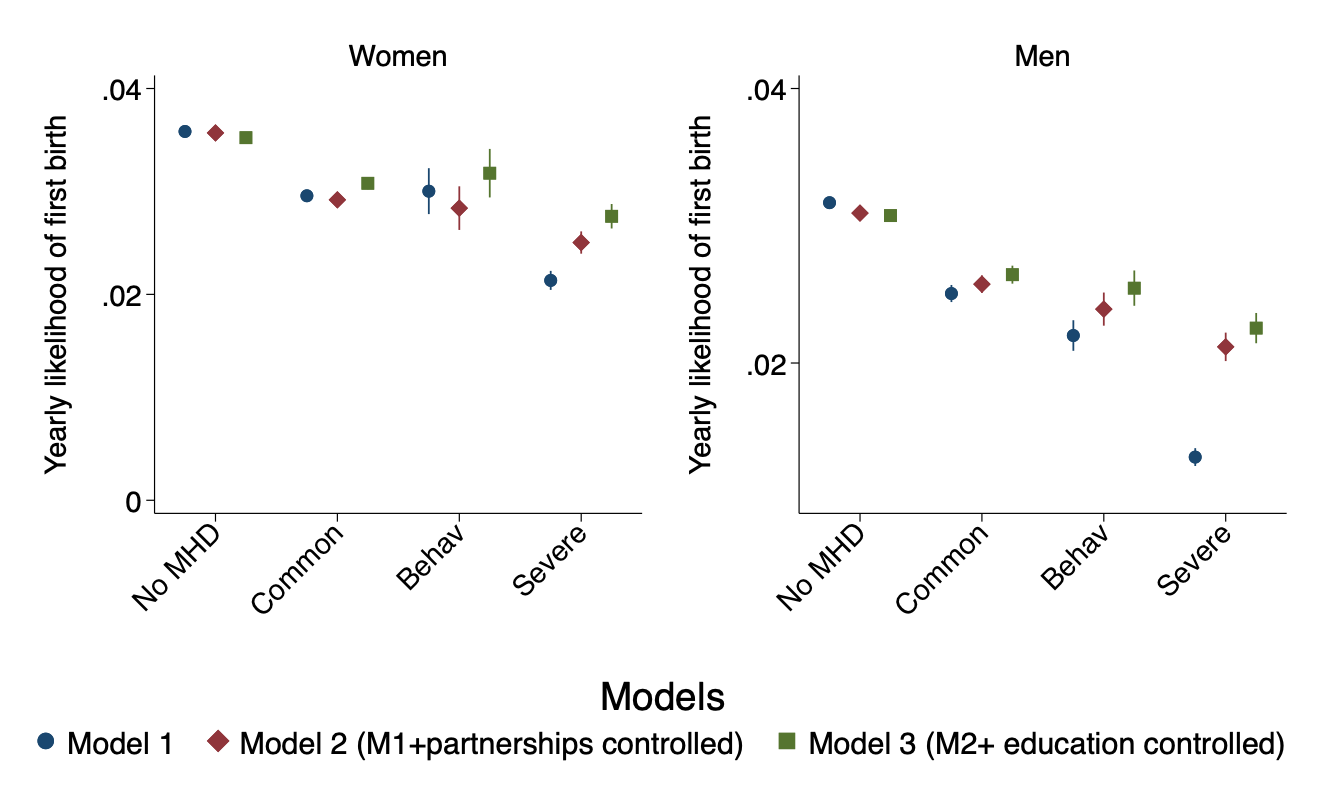
Figure 1. Probability of first birth by mental health disorder. Results are based on event history models and presented as predicted probabilities. Common= e.g. depression and anxiety; Behav = e.g. substance use disorders; Severe = e.g. psychotic disorders and schizophrenia ; prob. = probability, MHD = mental health disorder
Methods
The study is based on Finnish total population register data covering all individuals residing in Finland. Individuals were followed from age 18 to 39 (birth cohorts 1977–1980), including information on their partnerships and transitions to parenthood. Mental health disorders were measured using register data on psychotropic medication purchases and diagnoses from specialized health care. The analysis was conducted using event history methods. The study examines the association between different types of mental health disorders and the probability of first birth, with particular attention to partnership status and the partner’s mental health.
Further information
Postdoctoral Researcher, PhD anna Kailaheimo-Björkqvist, Institute for Social and Population Research, University of Helsinki
sanna.kailaheimo-bjorkqvist[at]helsinki.fi, tel. 050 308 3092
Kailaheimo-Björkqvist, S., Nisén, J., Metsä-Simola, N., Martikainen, P., & Myrskylä, M. (2026) Linking mental health disorders to childlessness: The roles of disorder type and partnership. Journal of Family Research, vol. 38.
Funding
This research was funded by the Strategic Research Council (SRC), the FLUX consortium (grant numbers 364374 and 364375), the Academy of Finland (grant number 363724), and the European Research Council under the European Union’s Horizon 2020 research and innovation programme (grant agreement No. 101019329). Additional funding was provided by the SRC-funded LIFECON project (345219), the Academy of Finland INVEST flagship (320162), the National Institute on Aging (R01AG075208), and grants to the Max Planck – University of Helsinki Center from the Max Planck Society (5714240218), the Jane and Aatos Erkko Foundation (210046), the Faculty of Social Sciences at the University of Helsinki (77204227), and the cities of Helsinki, Vantaa, and Espoo. Further support was provided by the European Union (ERC Synergy Grant BIOSFER, 101071773).
The views and opinions expressed are those of the authors and do not necessarily reflect those of the European Union or the European Research Council. Neither the European Union nor the funding bodies can be held responsible for them.
References
Andersson, L. (2023). A novel macro perspective on family dynamics: The contribution of partnership contexts of births to cohort fertility rates. Population and Development Review, 49(3): 617–649.
Golovina, K., Niemi, R., Gutvilig, M., Jokela, M., Elovainio, M., & Hakulinen, C. (2025). Mental Disorders and Having a First Child Among Young Adults: A Nationwide Register‐Based Cohort Study. BJOG: An International Journal of Obstetrics & Gynaecology, 132(8): 1147–1155.
Kailaheimo-Björkqvist, S., Nisén, J., Metsä-Simola, N., Martikainen, P., & Myrskylä, M. (2026) Linking mental health disorders to childlessness: The roles of disorder type and partnership. Journal of Family Research, vol. 38.
Kailaheimo-Lönnqvist, S., Moustgaard, H., Martikainen, P., & Myrskylä, M. (2024). Own depression, partner’s depression, and childlessness: A nationwide register-based study. Social Science & Medicine, 361, 117356.