
Finnish fertility: First births matter even more than before and lifetime fertility outlook has weakened
Flux Policy brief 02/2026: To support decision-making, the article provides an analysis of fertility trends through 2024, along with an assessment of how lifetime fertility of women currently of childbearing age is likely to develop.
Julia Hellstrand and Marika Jalovaara
Main findings of the updated analysis
- Entry into parenthood is increasingly delayed or forgone: Declines in first births account for about 82% of Finland’s fertility decline between 2010 and 2024.
- The change in childbearing among parents has largely stabilized: The overall decline in second- and third-order births is driven mostly by fewer women becoming mothers, and less so by parents having fewer additional children.
- Lifetime fertility is now falling sharply: Women’s lifetime fertility is projected to decline from long-standing levels of around 1.90 children to below 1.56 children among cohorts born in the early 1990s.
Finland’s recent fertility decline has continued for more than a decade and fertility has reached historically low levels. Lifetime fertility is projected to reach unprecedented lows for younger cohorts, underscoring more strongly that Finland’s low fertility outlook reflects a lasting shift in family formation rather than a temporary delay.
These trends have important implications for both individuals and society. At the population level, fewer births put pressure on societal sustainability. At the individual level, many people have fewer children than they desire.
Because first births are the key driver of the overall decline, policies that support the early stages of family formation and first-childbearing are likely to have the greatest impact on mitigating the fertility decline.
The fertility decline continues
Fertility is usually measured using the total fertility rate (TFR), an up-to-date, age-standardized measure that enables comparisons across time and between countries or regions, regardless of population size or structure. The TFR represents the average number of children a woman would have over her lifetime if fertility remained at the levels observed in a given calendar year.
In Finland, fertility has fallen sharply over the past 14 years (Figure 1). The TFR declined from 1.87 children per woman in 2010 to a record low of 1.35 in 2019, followed by a temporary increase during the COVID-19 pandemic. Since then, fertility has resumed its downward trend, reaching 1.25 in 2024, a new historic low. Preliminary data from Statistics Finland show that fertility was slightly higher, at 1.30, in 2025.
Earlier research (Hellstrand et al., 2021) using data through 2010 to 2018 showed that declines occurred across nearly all ages under 40, with limited potential for catch-up at older ages. Women born in the late 1980s were projected to have at most 1.75 children on average by the end of their reproductive years, down from the long-term stable level of about 1.9 children observed over the preceding three decades.
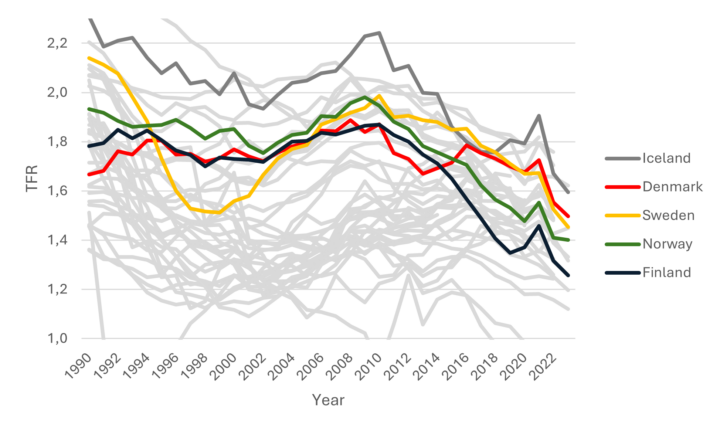
Figure 1: The total fertility rate (TFR) in Finland and the Nordic countries (highlighted) and other high-income countries (in grey), 1990-2025. (Human Fertility Database 2026, Official Statistics of Finland (OSF) 2026.)
Figure 2 shows how fertility rates by age have changed for first, second, and third children over time. When measured relative to all women, fertility rates have declined across nearly all ages and birth orders, reflecting a broad reduction in childbearing.
This population-level perspective highlights the overall decline in childbearing, but it does not reveal why the decline is occurring — whether it is driven mainly by fewer people having a first birth or by changes in childbearing behavior once parenthood has been entered. To understand the underlying drivers, we examine fertility by age and stage of family formation.
Falling first-birth rates increasingly important drivers of the total fertility decline
We compare first births among women without children, second births among women with one child, third births among women with two children and so on — allowing us to quantify which transitions contribute most to the overall decline. The results show that the decline in fertility is overwhelmingly due to reductions in first births, which account for approximately 82% of the overall fertility decline (Figure 3).
Because fewer women are having their first biological child, there are automatically fewer women who could go on to have a second or third child. This explains the decline in higher-order births. Between 2010 and 2018, about 75 percent of the overall decline was due to fewer women having first births. The updated analysis through 2024 shows that the importance of first births has increased even further, now accounting for an even larger share of the fertility decline.
Childbearing among women who already have at least one child has remained largely stable. The births of second and third children each explain roughly eight percent of the fertility decline, while the occurrence of fourth or higher-order births has changed very little.
Importantly, there is not much evidence of compensatory increases at older ages, indicating that postponed first births are not fully compensated for later in life.
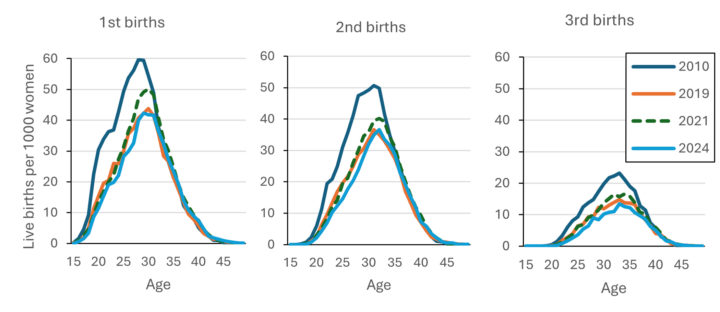
Figure 2: Age-specific fertility rates by birth order in 2010, 2019, 2021 and 2024. (Human Fertility Database 2026).
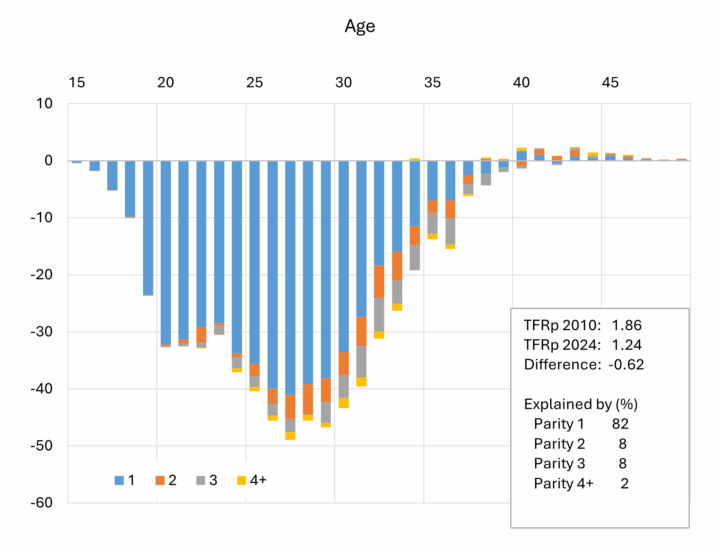
Figure 3: Age and parity (birth order) decomposition of the TFRp between 2010 and 2024. TFRp is a measure of total fertility adjusted for both age and parity. (Human Fertility Database 2026; Hellstrand et al. 2021 updated analysis)
Weakened outlooks for lifetime fertility
The total fertility rate (TFR) provides a current snapshot of fertility in a given year. However, it is a hypothetical measure and is sensitive to short-term fluctuations as well as changes in the timing of childbearing. Lifetime fertility — that is, the average number of children women actually have by the end of their reproductive years — gives a more reliable picture of long-term trends.
Observed lifetime fertility has already begun to decline. Among women born in the mid-1970s, average lifetime fertility was about 1.9 children, similar to many preceding cohorts. For women born in 1980, the average number of children was 1.82, representing a clear change from earlier cohorts. For younger cohorts still of childbearing age, lifetime fertility is projected using multiple methods, all of which indicate a continued decline (Figure 4).
In the most optimistic scenario, in which some births occur at older ages, women born in the early 1990s are projected to have an average of 1.56 children. If age-specific fertility rates remain at current levels, the lifetime fertility would be around 1.48 children per woman. In the most pessimistic scenario, lifetime fertility would fall further to 1.40 children per woman. At the population level, this corresponds to 340–500 fewer children per 1 000 women compared to previous generations. This is well below Finnish fertility ideals, as surveys show that the majority of people wish to have at least two children (Family barometer 2022).
Compared with trends in the total fertility rate, the decline in (forecasted) lifetime fertility shows that low fertility is not merely a short-term fluctuation or merely the result of fertility postponement. While annual TFRs may temporarily rise or fall due to changes in the timing of childbearing, forecasts of lifetime fertility indicate that women currently of childbearing age will have considerably fewer children than previous generations. For now, forecasted lifetime fertility remains higher than annual TFRs, which means that the current trajectory is slightly more favorable than the TFR alone suggests.
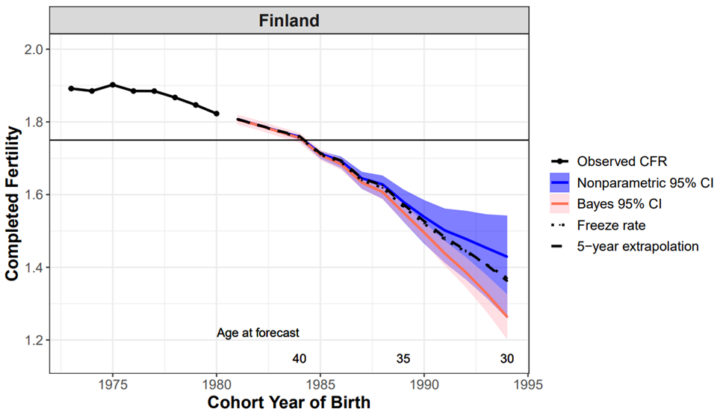
Figure 4: Observed (women born 1973–1980) and forecasted (women born 1981–1991) lifetime fertility. The horizontal line at 1.75 children per woman marks the commonly used threshold between low and very low fertility. (Human Fertility Database 2026; Hellstrand et al. 2021 updated analysis)
More information
Postdoctoral researcher Julia Hellstrand, University of Helsinki, julia.hellstrand@helsinki.fi
Professor Marika Jalovaara, Turun yliopisto, marika.jalovaara@utu.fi
Funding
The research was supported by the Strategic Research Council (STN) and the FLUX consortium (decision numbers 364374 and 364375).
References
Hellstrand, J, J Nisén, V Miranda, P Fallesen, L Dommermuth, and M Myrskylä. 2021. ‘Not Just Later, but Fewer: Novel Trends in Cohort Fertility in the Nordic Countries’, Demography, 58: 1373-99.
Human Fertility Database 2026. Max Planck Institute for Demographic Research (Germany) and Vienna Institute of Demography (Austria). (Accessed 10.2.2026)
Sorsa, T, Lehtonen N & Rotkirch A. 2022. Perhebarometri 2022. Kuka haluaa lapsia 2020-luvulla? [online publication, in Finnish] Väestöliitto ry. (Accessed 10.2.2026)
Official Statistics of Finland, (OSF): Preliminary population statistics [online publication]. ISSN=1798-8381. Helsinki: Statistics Finland. (Accessed 12.2.2026)